
Insights & ResourcesPractical framework

Practical framework

Capability Development Roadmap

By Jackie Digue

Developing capability is not just about training people. It’s about helping them build the confidence, practical skills, and support to take ownership of their work.

As organisations adopt AI and new technologies at an increasingly rapid pace, I believe we need to give just as much attention to developing our people as we do to implementing the technology.

I've put together this Capability Development Roadmap to illustrate a practical, repeatable approach to building skills and supporting lasting change.

It starts with leadership alignment and an honest assessment of where people are today. From there, the focus shifts to learning through practice, coaching, measuring progress, and building the internal capability to sustain the change.

One aspect I feel particularly strongly about is learning by doing. A training session might introduce a concept, but it is through practical application, feedback, and shared learning that people really begin to develop confidence and capability.

And we shouldn't overlook the importance of experienced colleagues who can coach others, share their knowledge, and help new team members find their feet during the initial period of implementation.

For me, this is where transformation and change management can add real value — working alongside the project, technical teams, business leaders, and learning specialists to make sure new capabilities become part of everyday working life.
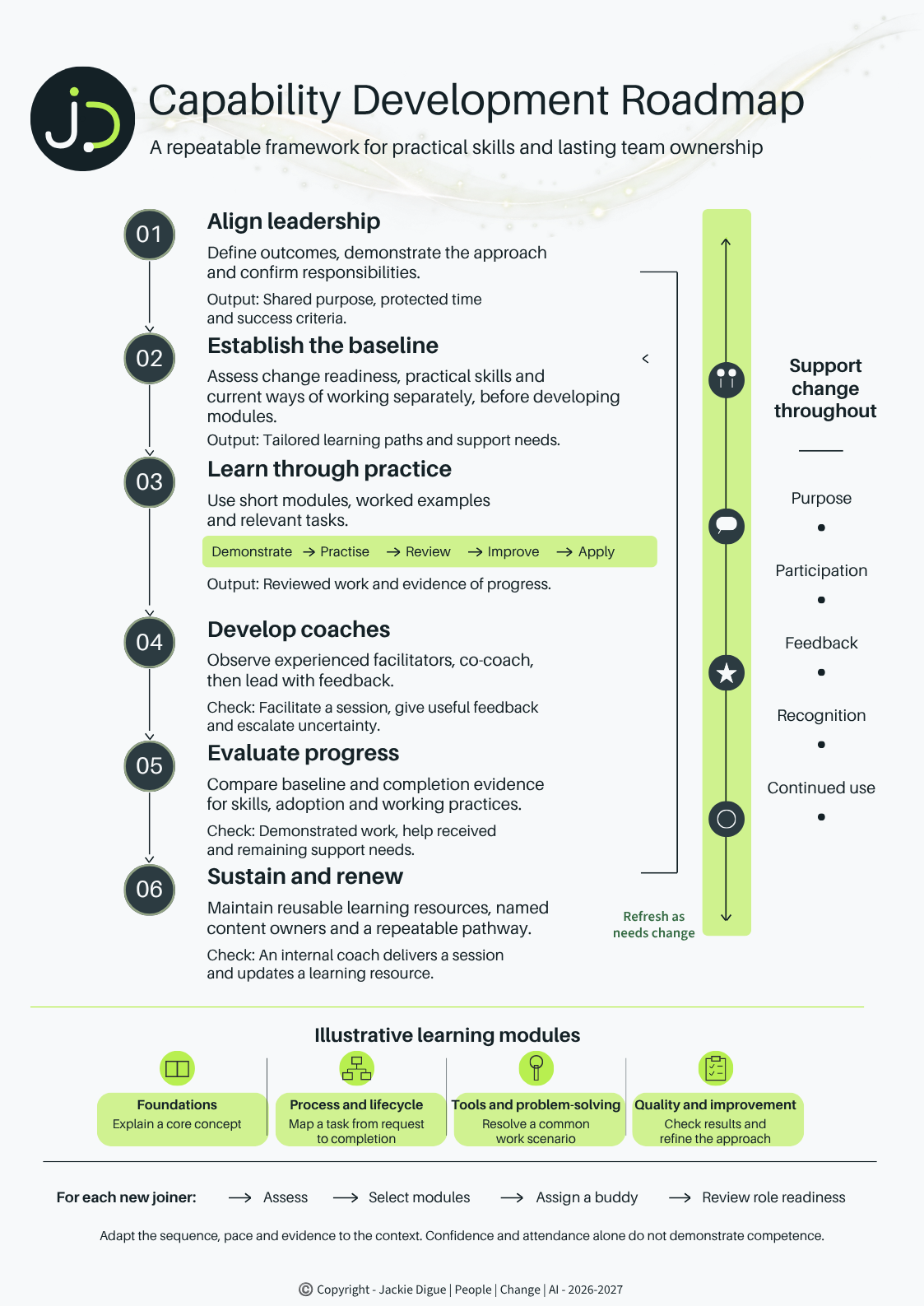
Jackie Digue’s six-stage Capability Development Roadmap, from leadership alignment to sustaining and renewing capability. A complete text version is provided below the graphic.
View full-size graphic · Download the roadmap
Read the roadmap as text

A repeatable framework for practical skills and lasting team ownership

  1. Align leadership

    Define outcomes, demonstrate the approach and confirm responsibilities.

    Output: Shared purpose, protected time and success criteria.

  2. Establish the baseline

    Assess change readiness, practical skills and current ways of working separately, before developing modules.

    Output: Tailored learning paths and support needs.

  3. Learn through practice

    Use short modules, worked examples and relevant tasks.

    Demonstrate → Practise → Review → Improve → Apply

    Output: Reviewed work and evidence of progress.

  4. Develop coaches

    Observe experienced facilitators, co-coach, then lead with feedback.

    Check: Facilitate a session, give useful feedback and escalate uncertainty.

  5. Evaluate progress

    Compare baseline and completion evidence for skills, adoption and working practices.

    Check: Demonstrated work, help received and remaining support needs.

  6. Sustain and renew

    Maintain reusable learning resources, named content owners and a repeatable pathway.

    Check: An internal coach delivers a session and updates a learning resource.

Support change throughout

  • Purpose
  • Participation
  • Feedback
  • Recognition
  • Continued use

Refresh as needs change.

Illustrative learning modules

  • Foundations: Explain a core concept
  • Process and lifecycle: Map a task from request to completion
  • Tools and problem-solving: Resolve a common work scenario
  • Quality and improvement: Check results and refine the approach

For each new joiner

Assess → Select modules → Assign a buddy → Review role readiness

Adapt the sequence, pace and evidence to the context. Confidence and attendance alone do not demonstrate competence.

Copyright · Jackie Digue | People | Change | AI · 2026–2027